Blood, Milk, 神 | by Robin Anderson
Personal Essay | If the blood is deficient, the spirit, or shen, cannot rest.
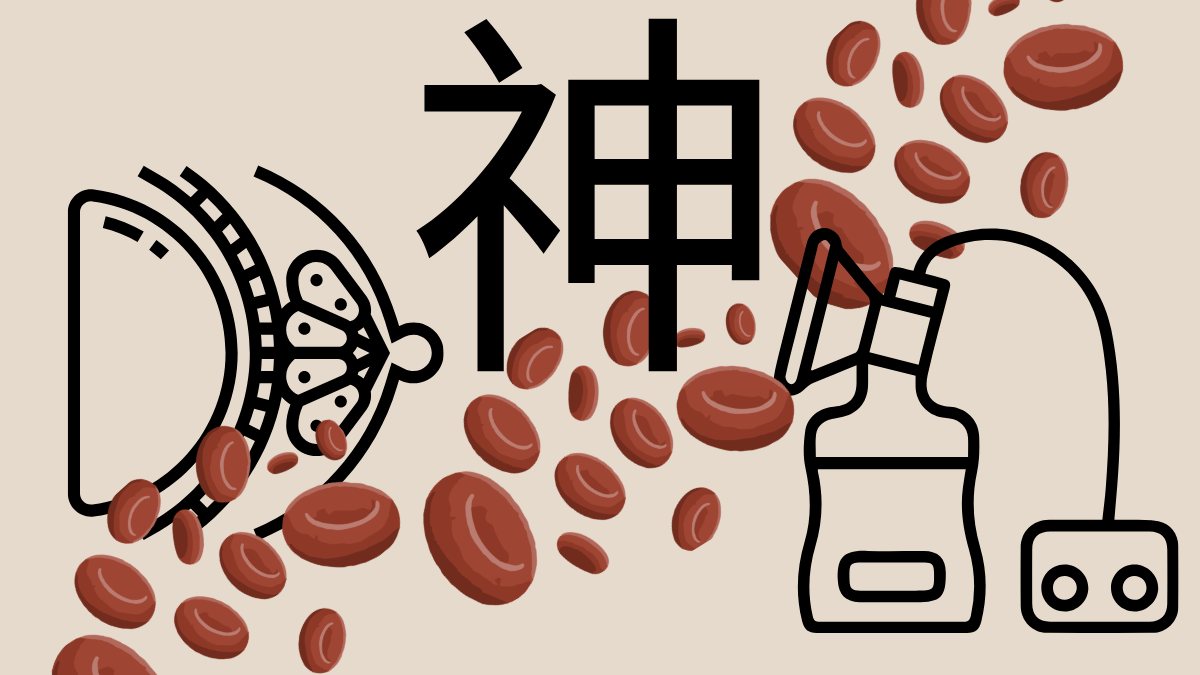
3am and it’s either too cold to sleep, or too hot. Wrists cannot be exposed; feet have to be. I startle awake with the fear she will be kidnapped out of our 2nd story window. I dream lucidly of cars careening on their sides down the freeway. I mostly do not sleep. Shen has nowhere to root. 神
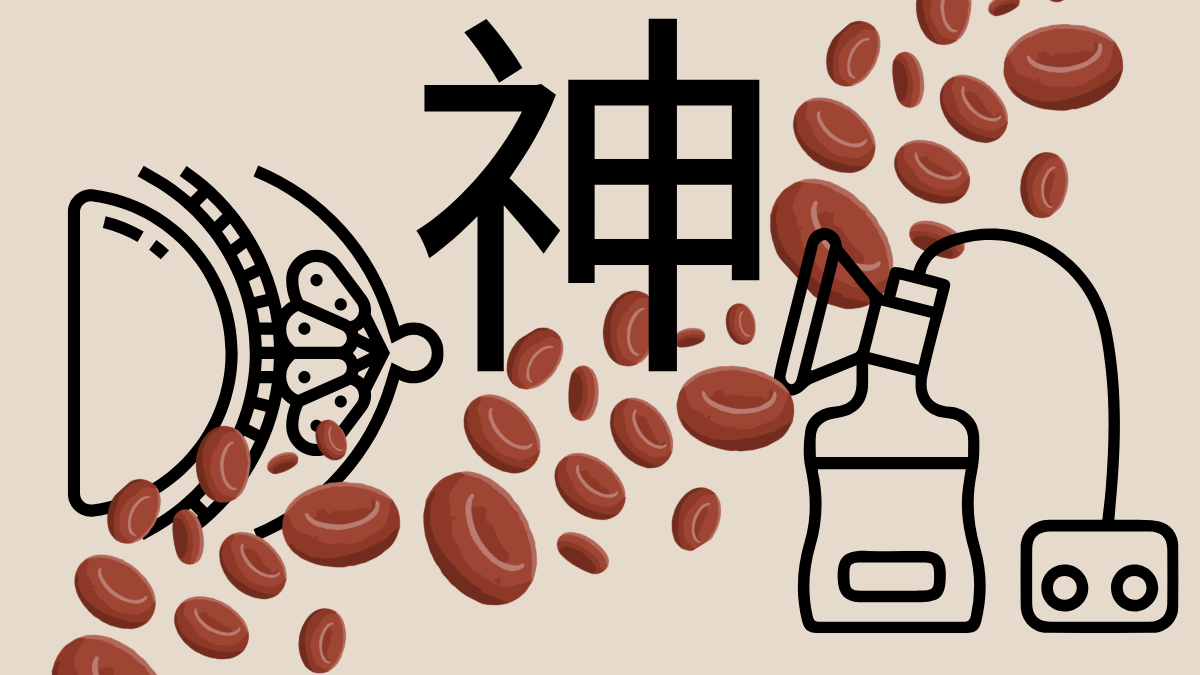
For any mother who has had the unshakable urge to check on her baby multiple times throughout the night, this is a rudderless shen.
I am a practitioner of Chinese medicine, and I just had a baby. I know some things. But at 3am, I’m not sure it matters.
For instance, I know that the health of one’s spirit, or shen, is so closely tied with one’s blood that it is impossible to speak of one without the other.
After my daughter was born, the first blood transfusion didn’t do much, so I had a second. But nine weeks later, I was still wearing a hospital-grade maxi pad with no discernible medical cause.
After an ultrasound had ruled out retained placenta, I had a call with a midwife. “Iron stores look fine. Have you tried extra vitamin C?” She asked. She was almost chipper. “I don’t really know how to help you. Maybe it’s time to try alternative medicine.”
Lady, I thought, I AM the alternative medicine.
If the blood is deficient, the spirit, or shen, cannot rest.
The Ling Shu, or Spiritual Pivot that serves as a core text regarding the theory of acupuncture says, “When Blood is harmonized, the Mind has residence”. It is said that the mind is housed or “embraced” by the nurturing, nutritious fluid, particularly at night.
Putting aside my shen, I also need to produce breastmilk with this blood-deficient body.
It hasn’t been going well.
From my studies, I cannot unknow the blood-milk-shen connection, and I currently cannot keep blood in my body.
In Western physiology, my floating shen and flimsy milk supply were considered mostly neurological issues, separate symptoms not connected to each other in any concrete way, utterly banal in their universality, nothing much to see here, take some Unisom as needed, and keep pumping.
The circular relationship between supply and demand from the baby’s mouth to the mother’s hypothalamus via the nipple describes the lens that most medical professionals operate under, with vague references to the impacts of stress and nutrition. But essentially, more stimulation equals more production. Not untrue, but not complete.
Here’s what I know:
“Breast milk is a product of the transformation of Qi and blood…without Qi breast milk cannot be transformed, without blood it cannot be generated.” ~Fu Qing Zhu’s Gynaecology
Milk cannot be generated, I hear in my head as I lay a towel down over the mattress to prevent another rust-colored stain. I am not generating milk.
My new-mother thoughts are macabre instead of cute and cuddly. Red, wet, obsessive. Blood running in rivulets. Thick pools of red. Building blocks of mother’s milk, scaffolding of the mind, transporter of oxygen, nutrients and warmth. I miss it.
If the mother’s well-being is meant to be the pillar of a healthy family, then we are in trouble.
Shen has nowhere to root, I think in the dark, between nightmares. There is not enough blood to hold shen. The mind has no residence.

After being prescribed pain pills for excruciating periods as a teen, I was drawn to Chinese medicine for the possibility of remedy. Pain pills could never answer the question of why my cycle kept me home from school. Chinese medicine rises to that challenge.
Sun Simiao, a renowned physician from the Tang dynasty famously said, “Women are 10,000 times more difficult to treat than men” because of our complexity, our cyclical nature, and our capacities for change. Because medical dismissal had happened to me at such an early age, the honor of being regarded as intriguing rather than a nuisance created a profound relief I could feel in my bones.
The significant blood loss I experienced monthly as a girl meant something in this world, aside from practical matters of iron stores and hematocrit. Blood, in Chinese medicine, influences cognition, mood, strength of voice, sleep. Vision, both physical and metaphorical. Relationship patterns. Dreams. Motivation. Ability to love, and to receive love in return.
It is known as one of the five “Vital Substances” of the body, not just in volume, but in quality.
Taking my place in the clinician’s seat, I have heard everything from menstrual blood being dry and flaky in the underwear, to thick and clumpy, like strawberry jelly. These variations reflect different constitutions, the basics of physiology boiling down to damp vs dry, hot vs cold, excess vs deficiency.
The continuum of Yin and Yang. Blood and Qi.
Postpartum, I didn’t have enough of anything. There was no continuum to be on.
I lost too much blood, then was too weak from the birth itself to effectively manufacture more. Qi was deficient, the life force that holds blood in the body, circulates it, and proliferates more. I was a week in the hospital, never a moment’s peace, no sleep for longer than a few hours without a nurse poking at me. I could not recoup what was lost.
Prior to birth, I figured my master’s in Chinese medicine would buffer the pitfalls and failures of birth in North America. An ace up my sleeve, I thought. I’ll be fine. I know a lot.
But a new mother cannot care for herself, regardless of how much she knows.
I left the hospital with the infant car seat bumping my leg, initiating the modern American mother’s ritual of being released into the bright, normal world, stunned and bleeding, with vague recommendations to “rest” and “eat well”.
My first meal at home was a frozen pizza. I stood barefoot on the cold kitchen floor, waiting. I inexplicably told my husband I would handle dinner. He didn’t know he should have guided me back to bed. He believed me when I said I wanted to be in the kitchen, shivering. I believed me, too.
Of course, I knew about the traditional cultures that emphasize specific postpartum nutritional protocols-the Chinese congee, the Mexican atole. They all share the emphasis on warming, soupy meals often rich in collagen that are cooked until the ingredients are falling apart, nutrients easy to assimilate for a new mother, with her tender organs still smashed up to her ribs.
I truly believed I would be the one making those meals for myself.
I didn’t know the vision of this robust woman at the stove, a baby in one arm and a ladle in another, reflected not a symbol of empowerment; it reflected a normalized dearth of care for new mothers, a kink in the divine plan of procreation that had plagued women in my family, my culture and community for generations now.
I didn’t know how much blood I was going to lose.

So the fact that I am awake is irrelevant, really, because I have the alarm set for 3:30am, when I will pick up my shipwrecked body and sit her on the cold edge of the bathtub. I will hook up plastic pieces to my breasts, the hospital-grade pump with incomprehensible tubing, knobs and funnels, and pray for at least two ounces.
Four brown vials of herbal tinctures await my decision downstairs, finally purchased after that useless phone call with the midwife. Tinctures of herbs from the Stop Bleeding category in the Chinese medical pharmacopeia. But they could also diminish my milk supply even further.
I want to bounce this decision off of someone, but herbs are not in anyone on my care team’s scope of practice. Plus, they’re dead to me anyway. Yes, I’m an herbalist myself, but my blood-starved brain doesn’t work right now. I cannot strategize. I need a mentor, a wise woman, a grandmother to guide me. Warm, knowing hands, gentle words. Instead, I have been offered birth control and anti-depressants, but no real plan for the continuous loss of fluid, nutrients, and raw material for sustaining life-my life- that is blood. The focus remains on the volume of milk produced, but not the vessel from which it comes.
Tonight, I cannot decide, and I know I won’t once daylight comes either. I squeeze out just under two ounces in total, unhook, and lumber off to bed where my shen hovers just a few feet above me. 神
Robin Anderson is a writer, mother, and Chinese medicine practitioner, with a focus on women’s health and perinatal care. Her creative spark comes from her love of literature, motherhood, and background in anthropology. Robin lives in Washington state with her partner and their six-year-old daughter.
 PodBean Development
* NEW EPISODE *
Jaclyn hosts these groups to help us reveal the whole women we are, our under-stories, our under-voices, our undenability. Meets monthly at our Discord.
PERK FOR THE PYTHIA / $8 LEVEL & UP
Corra (free) and Yacumama ($2) members may join sessions with a $6 ticket each month as desired.
Reach out anytime for any reason: info@medusarising.org.
Find us everywhere we are with the social web: @gorgons@medusarising.org.
( ^-^)ノ∠※。.:*:・'°☆ ( ^-^)ノ∠※。.:*:・'°☆ ( ^-^)ノ∠※。.:*:・'°☆