Razia Sultan: How a Story Became My Language of Feminism | by Srijani Mitra
Personal Essay | Historical Heriones & Archetypes
My first understanding of feminism did not come from a classroom, a manifesto, or even a book that called out injustice outright. It came through a story, one I encountered long before I had the words to understand what it was teaching me. It came through Razia Sultan.
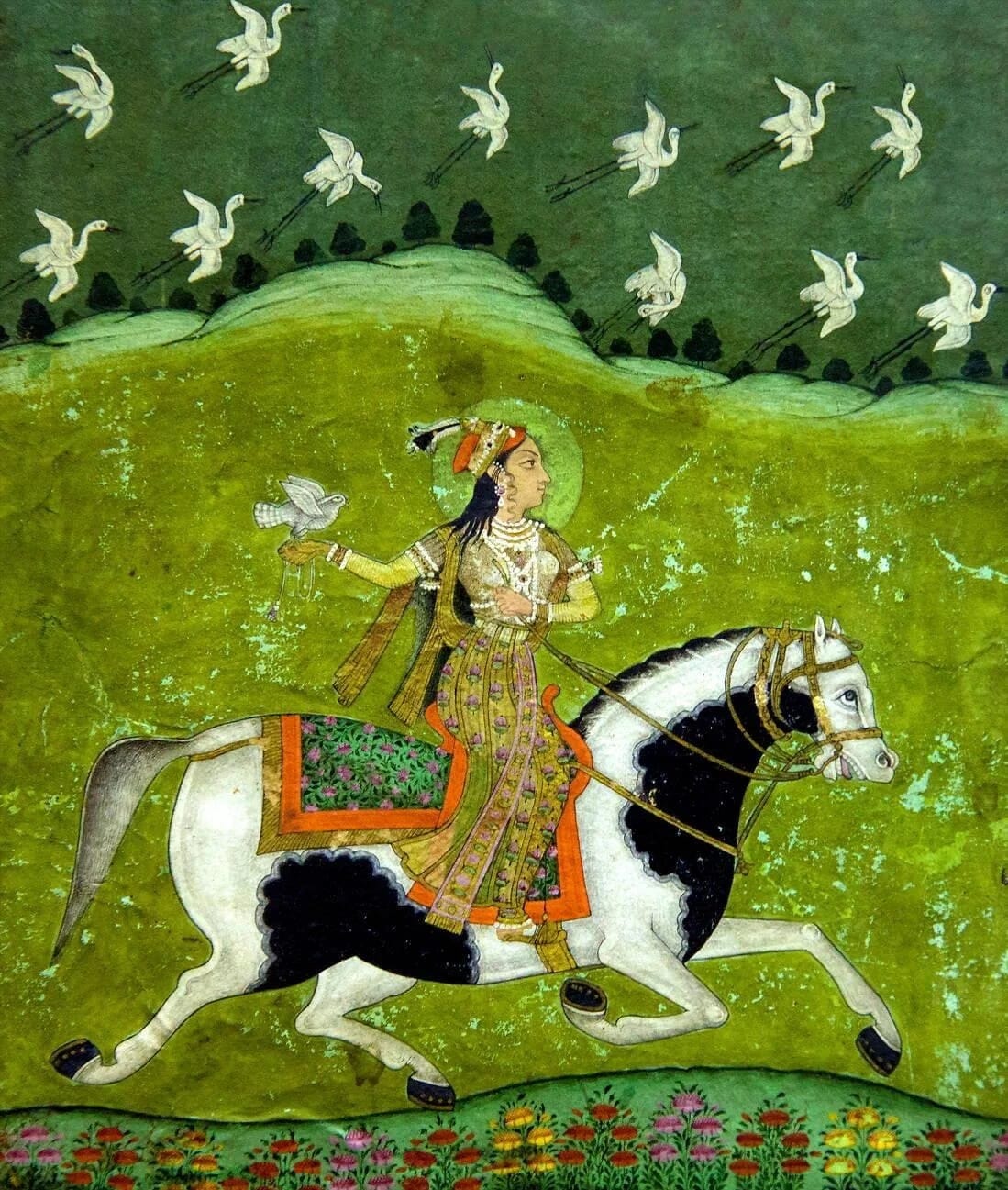
I learned her name as a child, when history still felt half-mythical and stories travelled like secrets. Razia was spoken of as something almost unbelievable, a woman who ruled Delhi, who led armies, who sat on a throne built to exclude her. She arrived in my imagination not as an academic figure, but as a disruption. She unsettled something before I knew it needed unsettling.
I did not know the word “feminism” then. But I knew what it meant to be told, quietly and repeatedly, to shrink.
Razia Sultan and the Possibility of Defiance
Razia Sultan became my first vocabulary for courage. I read her story obsessively in Amar Chitra Katha, and later watched the television adaptation of her life with unwavering attention. What fascinated me was not only that she ruled, but how she ruled. She rules by refusing to perform femininity as submission. She wore what she wanted, led whom she chose, and challenged the idea that power belonged naturally to men.
Only much later did I understand the political stakes of her reign: the hostility of the nobility, the fragility of her rule, the way her authority threatened entrenched hierarchies. But as a child, I understood something more instinctive. Razia represented proof. Proof that women’s power was not an invention of modernity, not an anomaly, not a mistake. Proof that the world had lied to me about what women could be. Her story mattered because nothing in my immediate reality resembled her.
Growing Up Inside Violence
My childhood was shaped by an early intimacy with violence, not the spectacular kind, but the quiet, domestic kind that reorganizes your body before it reaches your mind. Violence that lives in closed doors, in sudden silences, in the constant scanning of moods. Violence that teaches a girl to be alert, compliant, and afraid. There was physical abuse. There was emotional control. There was the constant reminder of hierarchy, who spoke, who decided, who was allowed anger, and who had to endure it. I learned very early that power could wound, that silence could be a form of survival, and that obedience was often demanded in the name of love. I did not yet have the language to call this patriarchy or abuse. But I understood injustice intimately. I understood that my body was not fully mine. I understood that raising my voice came at a cost.
Starting at $2 USD per month | Access to complete posts, Gorgon Posse videos, Commenting & conversation, External reading recommendations, & Special Event invitations.
First month always free.
And yet, alongside this reality, there existed the image of Razia Sultan, riding into battle, ruling a nation, refusing containment. The contrast was jarring. But it was also sustaining.
Writing as Survival, Writing as Resistance
In that house of fear, I began writing poems in a diary. I did not know I was practicing resistance. I only knew that writing gave me air. It was the one space where my voice could exist without interruption. Once, my parents found that diary. They tore my poems. That moment clarified something fundamental for me: writing was dangerous because it made me autonomous. It was dangerous because it named feelings that were meant to stay buried. The act of destroying my poems was not accidental, it was actually control asserting itself.But it did not stop me.This is where my feminism began, not in theory, but in practice. In choosing to write again. In refusing silence. In continuing to imagine a self beyond the structure that confined me.
Around the same time, the television series on Razia Sultan aired. Watching her on screen, assertive, unafraid, commanding,I began to understand defiance not as a single revolutionary act, but as a series of small, persistent refusals. Just as Razia’s everyday acts of resistance accumulated into sovereignty, I began to believe that my small acts like writing poems, raising my voice, refusing erasure, could lead me out of abuse and toward independence.
Learning Feminism Before the Word
Feminism did not arrive for me as a sudden awakening. It arrived slowly, through instinct and survival. Through the quiet realization that endurance was not destiny. Razia Sultan taught me this long before feminism became formal language. Her story offered me a counter-reality, one where women could lead, command, and exist unapologetically. My own life taught me why that reality mattered. Violence educated me in hierarchy. Story educated me in possibility.
Coming to Feminism, Naming the Known
When I finally encountered feminism through books, classrooms, and discourse, it felt strangely familiar. Feminism did not introduce new ideas, it named what I had already lived. It gave structure to my instincts. It explained why fear was systematic, why silence was expected of girls, why my resistance, however small,was political.
By then, Razia Sultan’s story had deepened for me. I understood the cost of her defiance, the erasures she suffered, the threat she posed to patriarchal order. She was no longer only a queen from my childhood, she was a feminist figure before feminism had language.
My first publication, especially my writing on women’s lives and pain, affirmed this understanding. It made visible what had once been private. It allowed me to see myself not only as a survivor, but as a feminist, someone participating in a lineage of women who resist through words.
Believing Women Deserve More
At its core, my feminism is shaped less by anger than by grief. Grief for the ways women are trained to endure. Grief for the silences embedded in girlhood. Grief for how early we are taught to accept fear as normal.
But alongside that grief exists belief. The belief that Razia Sultan’s world, where a woman could rule, defy, and command, is closer to the truth of what women deserve than the world that taught me to be quiet. The belief that feminism often begins privately, as a refusal to accept injustice as inevitable.
I am still practicing it. Still writing. Still leaving behind old structures of harm. Still believing that small acts can transform entire lives.
Srijani Mitra is a poet and writer based in India published in Scroll, Sahitya Akademi, North Dakota Quarterly and South Seattle Emerald.
MR is an autonomous RadMatFem project.
Tip for the contributors!
We are our only algorithm!
More connection! More sharing!
Thank you for supporting Medusa Rising.
Your solidarity means the world to us, cousins.
Reach out anytime for any reason: info@medusarising.org.
Ghost collects no info on our subscribers. We own our list. Medusa Rising neither shares nor sells that list. !! Feminist Safety First !!
( ^-^)ノ∠※。.:*:・'°☆ ( ^-^)ノ∠※。.:*:・'°☆ ( ^-^)ノ∠※。.:*:・'°☆