The Goddess We Fear in Flesh | by Nehal Sharma
Essay | Bonus | Fierce Embodiment & Dark Feminine

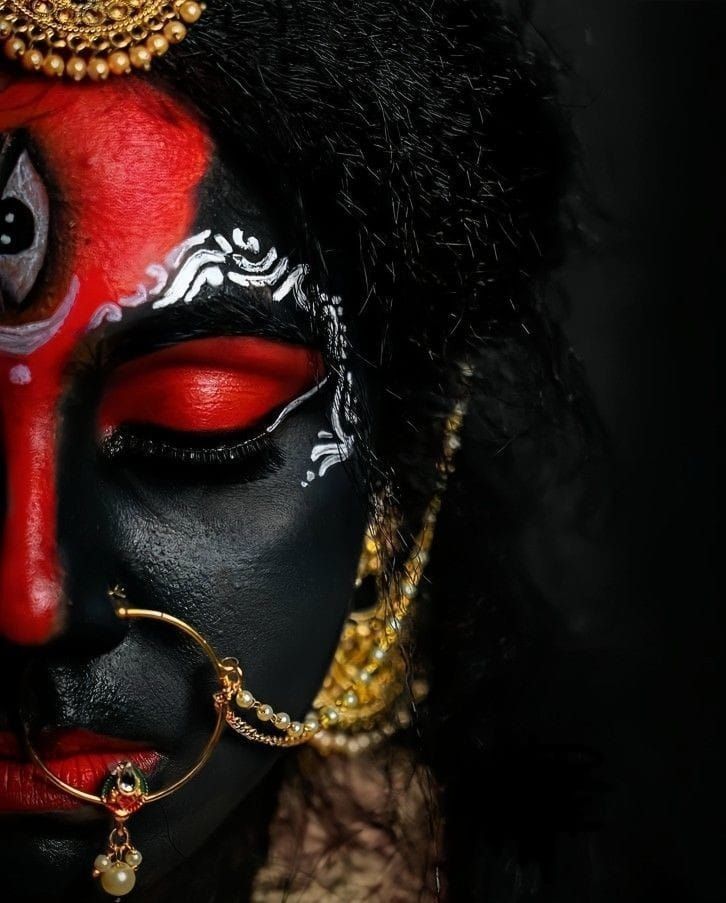

I grew up in a home where the gods stared back. From every wall hung a calendar, each month replaced not by landscapes but by faces of power. Lakshmi on the cupboard, Saraswati near the study table, and Kali, always above the threshold, as if guarding entry. My mother often said, “The Devi destroys demons.” I never realised then how many of those demons lived in us, in the quiet rules that told me how to sit, how to speak, how not to be so loud as to disturb the gods themselves.
I think of that now, and realise it was never just about theology. It was about what happens when myth becomes mirror, and reflection turns into restraint.
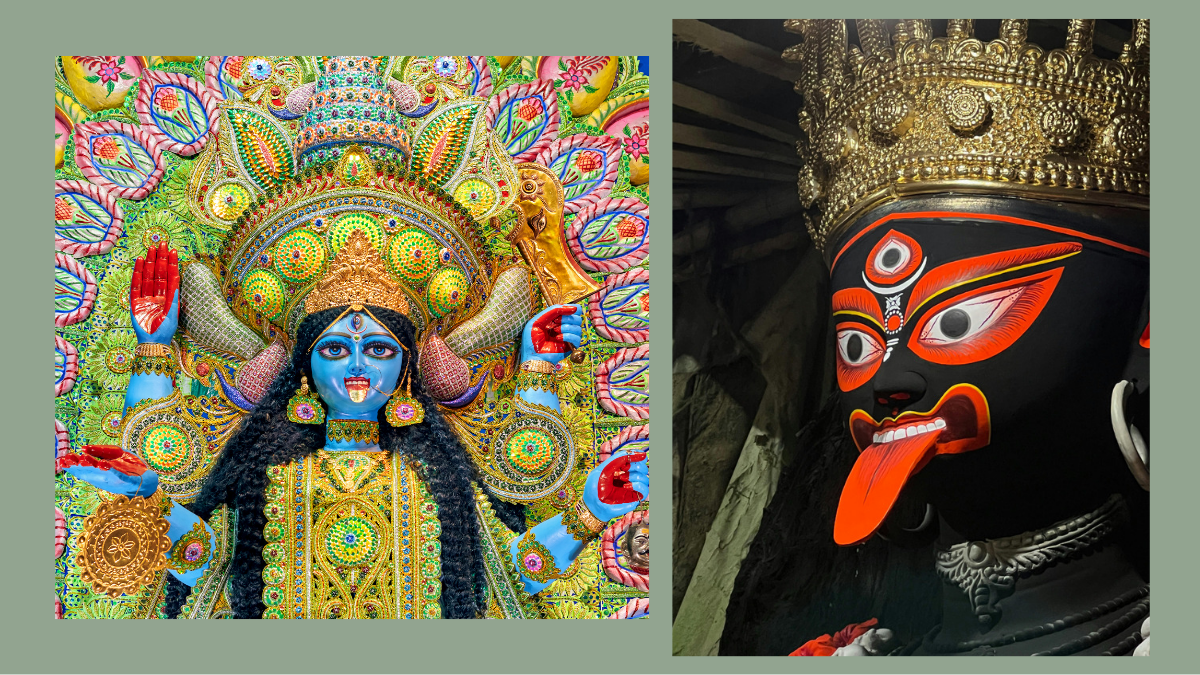
The first time I saw Kali, I was six. She is painted in blood-red, tongue lolling, eyes wild with fury. We worship her during festivals, chant her name in times of fear, and place her idol in the holiest corners of our homes. My grandmother whispered that her tongue was red with blood, but not to be afraid. Years later, when a teacher called me “too bold,” I wondered why the same fire I was told to worship was suddenly unbecoming.
Even now, when a woman walks with confidence, or dares to break the mold, we call her “too much.” What does it say about us when we revere Kali in temples but reject her energy in our daughters?
The Art of Containment
In art, I found the same pattern. Raja Ravi Verma's goddesses are luminous but compliant; they gaze downward even while holding weapons. The visual tradition itself betrays the discomfort with divine rage. It is not blasphemy to paint her beautiful, but it is dangerous to paint her unapologetic. In film: Meenakshi in Kaali Kalyanam, Deepika's Padmavati, Nushrratt's Chhorii, rage repackaged as sacrifice. Even textbooks taught a domesticated version of mythology: Durga smiling demurely after killing Mahishasura; Draupadi grateful to be saved rather than furious about being disrobed.
I began to see this everywhere: the ways women are visually softened, their power always explained away as virtue.
Perhaps patriarchy doesn't silence the goddess. It curates her.
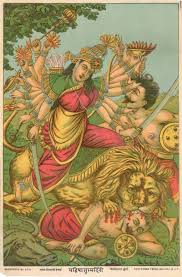
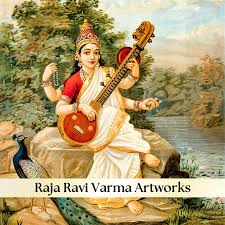
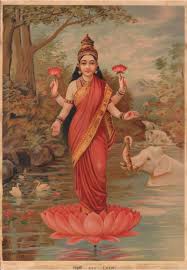
Durga | Saraswati | Lakshmi
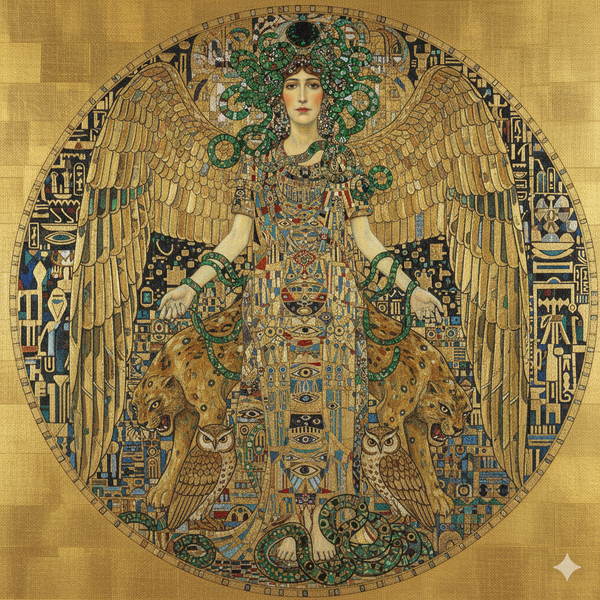
The pattern is not ours alone. The Greek Medusa was once a guardian symbol before men recast her as monstrous; Lilith in Jewish lore became a warning, not a woman. Across myths, female autonomy survives only as allegory, never as advice.
There is a paradox braided into the soul of our culture: one that bows before the goddess while binding the girl. The Dark Feminine, embodied most ferociously in Kali, is feared and revered in equal measure. She is the annihilator of ego, the devourer of illusion. Yet, her archetype is unwelcome in real life: when women mirror her assertiveness, they are dismissed as irrational; when they burn with her fury, they are pathologized.
But this rage is not a flaw. It is shakti. It is resistance. And perhaps, it is time we stop caging that power in festivals and idols, and begin letting it live in flesh and thought.
The Sanitised Goddess
The Dark Feminine is not a mere aesthetic of mysticism or rebellion. Chhinnamasta, Bhairavi and Chamunda were never ornamental or demure; they were warriors, embodiments of cosmic rage and righteous destruction. Their myths aren't just devotional stories; they are blueprints for how to confront power itself.
In Kali, we see not just death, but liberation. She steps on Shiva not to dominate the masculine, but to transcend the cycle of docility expected of the feminine. In Durga, we see not nurturing submission but autonomous violence wielded ethically, in response to oppression. These aren't exceptions to femininity; they are reminders of its depth, its plurality, its potential for dissent.
Yet, modern society has sanitised these figures. The radical energy of the goddess has been domesticated: made sacred, but never revolutionary. Patriarchy is clever not because it denies power, but because it repackages it into something palatable. Worship her, but only if she never moves.
Perhaps the greatest violence we have done to the goddess is intellectual: to turn her from a living archetype into an aesthetic.
Philosophy and the Powerful Feminine
As theorist Gayatri Spivak notes, power is often mediated through representation: if you can control how something is seen, you can control what it can do.
We witness this when Kali is painted gently, her wilderness softened. Durga becomes a mother first, warrior second. Sacred, yes, but no longer threatening.
This is how power works; it takes what it cannot destroy.
In college, I wrote my first paper on Foucault and realised I was writing about myself. His idea of the disciplined body felt less like theory, more like my diary. Every ‘don't’ I'd ever heard had an ancestor in philosophy.
The more I studied philosophy, the more I realised that Kali's story is less about religion and more about representation. Spivak warned us: whoever tells the story decides who gets to speak. Foucault called this “biopower”, control disguised as care. Butler later showed that even gender is a performance born of fear.
When I read these social thinkers, I didn't see theory. I realised that mythology had always been a manual for power, not in its content, but in its curation. Who tells the tale of Kali determines whether she is terrifying or triumphant. And who tells the story of a woman determines whether she's “too much” or simply human.
Sometimes, I wonder whether even our devotion is a form of fear, a way of keeping her contained by calling her divine, because to worship her is safer than to become her.
The Policing of Power
The rage of goddesses may be sanctified on altars, but when mirrored in living women, it becomes a threat to be subdued. The same traits celebrated in myth: assertiveness, autonomy, defiance of injustice, are pathologised in real life as hysteria or arrogance.
A woman who speaks her mind is “bossy.” One who claims space is “intimidating.” A woman who shows anger is “crazy.” Each insult feels ancient, like echoes of the same chant that once asked goddesses to sit down, not stand tall.
But that wildness, that Kali-shakti, is precisely what we need in a world that profits off submission.
The Mirror of Modernity
In recent years, I've started noticing traces of Kali in unexpected places. Not in temples, but on screens. Beyoncé in her Black is King album wears a golden halo and blood-red gown, invoking Oshun and Kali simultaneously: the goddess as mother, performer, destroyer. Phoebe Waller-Bridge's Fleabag ends not with redemption but confrontation, a woman's unapologetic grief made sacred through comedy. Even Alia Bhatt's Gangubai walks that delicate line between sinner and saint, her rage made political, her tears weaponised.
These women, fictional or otherwise, are modern goddesses of discomfort. They remind me that rage is not an act of rebellion, but of reclamation.
And yet, even now, I catch myself softening my tone in public, explaining my arguments so they don't sound like attacks. Sometimes I wonder if I, too, am a participant in this containment. Perhaps every woman carries two altars: one she bows before, and one she builds inside herself.
Maybe the work of our generation isn't to resurrect Kali, but to rehumanise her, to let the myth breathe through our contradictions instead of embalming it in perfection.
Why Reclaiming Her Matters
To reclaim the Dark Feminine is not to romanticise violence. It is to remember that Mahakali's garland of skulls is not grotesque, they are symbols of liberation, of that which refuses to be silenced or softened for comfort.
In a society that sells empowerment in pastel packaging, the Dark Feminine reminds us that real change doesn't come with a smile. It comes with fire.
I have felt her too: in my throat when I refused to apologise when right, in my hands when I wrote those words instead of swallowing them.
When a woman says no and means it. When a survivor names their abuser. When ambition wins over likability: that is Kali walking through us.
So perhaps it is time not just to loiter, as Shilpa Phadke urges, but to be feared, not because we are dangerous, but because we are done being domesticated.
Elements of Goddess as Motion
Let Her Rise
We are raised to believe goddesses exist somewhere above, beyond, apart. But what if divinity is simply permission? Permission to exist unsoftened.
When I walk now, I do not whisper apologies to the air. I remember her instead: the girl, the goddess, the mother, the myth, all collapsed into one. I think of her not as the goddess I fear, but as the one I finally resemble.
Maybe that's what worship was always meant to be: not devotion, but resemblance.
Kali does not ask to be accepted. She arrives. And so must we.
In a world that worships goddesses but punishes women who act like them, the most radical act is this: to become in flesh the goddess we fear.
Nehal Sharma is a writer and founder of the blog Mythology Meets Reality. Her work often explores how culture, emotion, and history shape contemporary womanhood. She has previously published with magazines like Roi Fainéant and The Chai Literary Magazine, and ranked 3rd globally in the Heartfulness Essay Competition. Writing is how she lives inside her own curiosity, turning observation into reflection and reflection into story.


NEW EPISODE ICYMI
Thank you for supporting this project.
We're honored to be in this work with you.
Reach out anytime for any reason: info@medusarising.org.
Find us everywhere we are with the social web: @gorgons@medusarising.org.
( ^-^)ノ∠※。.:*:・'°☆ ( ^-^)ノ∠※。.:*:・'°☆ ( ^-^)ノ∠※。.:*:・'°☆