Beyond Man the Hunter and Other Fractured Fairy Tales
Essay | Free | Matricor Newsletter Debut - Part 1: Modern Myths that need to die
Who are we? Human Nature
Myth is a social force, especially the stories people tell that frame our understanding of human nature. Our understanding of who and what we are determines what institutions we build, how we live, and what we consider acceptable. Our understanding of human nature forms our decisions about what we will or won’t put up with, whether we relate to each other as equals or not, gender norms, whether we allow governance with an iron fist or insist on open arms; how precious resources are distributed, how we deal with anti-social behavior; and, most importantly, whether our lives are full of joy or misery.
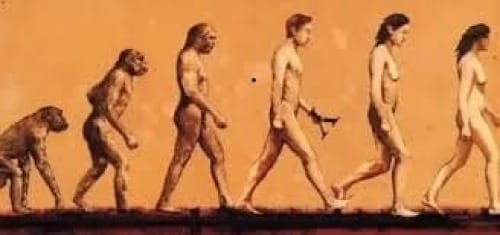
In this two part essay, I will present the long history of the ‘man the hunter’ myth and how it came to be the sticky trope that it is, so sticky as to be foundational to male supremacist orders globally. This myth is the foundation of Western Civilization and its social structure, patriarchy. Its complex trail of twists of meaning is so strong that it even overwrote hard science for most of our history. Part 1 frames this history as a conversation about what human nature is not, namely “man the killer ape, hunter, or apex predator. The deconstruction of this particular myth strikes at the epicenter of misogyny, framing male domination and savagery as natural and normal, and eliminates biology as an excuse to erase and abuse women. In Part 2, I will begin to explore the surviving systems untouched by this myth or patriarchal empire, that helped shape some early US feminist thought and that now stand to help us all survive the coming churn.
“Man the Hunter”
“Man the Hunter” is a trope that has infiltrated at least three major world religions and Hollywood, anthropology, and pop science, and is the ground floor of Western culture. The trope of male domination as the baseline of civilization has been mansplaining human history for roughly 5,000 years – beginning in the “cradle of civilization,” Mesopotamia ~2300 BCE, the beginning of the world’s first extractive empires.
The first recorded description of a mighty “hunter” and the violent empire he installs goes to hypothetical King Nimrod, cited in the book of Genesis. There was no actual King Nimrod as far as Biblical scholars can verify because the story is about empire as a violent system more than an individual. By making his persona condense several Bronze Age emperors into one character, the writers could criticize colonial overlords to reassure their people that emperors and empires come and go, so hold on tight. What is described is the approximate 250 year cycle where an aggressive war lord would conquer a number of cities to gain an economic advantage, overplay their power, be overthrown by the people, and then disappear until the next despot arrived. The Hebrew word used for King Nimrod is is gibor (גִּבּוֹר), which translates to a mighty warrior, tyrant, or warlord. The text goes on to ostensibly praise Nimrod as a "mighty hunter." While some interpret this literally as hunting animals, ancient Jewish historians like Josephus, as well as modern biblical scholars, note that "hunting" in the ancient Near East was a common metaphor for military conquest, subduing nations, hunting men, and taking women as slaves.This great hunter is the first story about hunter kings used to justify empires, just like the ones used until today.
Royal Hunt as Propaganda
The Neo-Assyrian kings (like Ashurbanipal and Sennacherib) were absolutely obsessed with royal lion hunts. Their palace walls in Nineveh were covered in massive, high-definition stone reliefs showing the king single-handedly slaughtering lions to prove his divine right to rule.

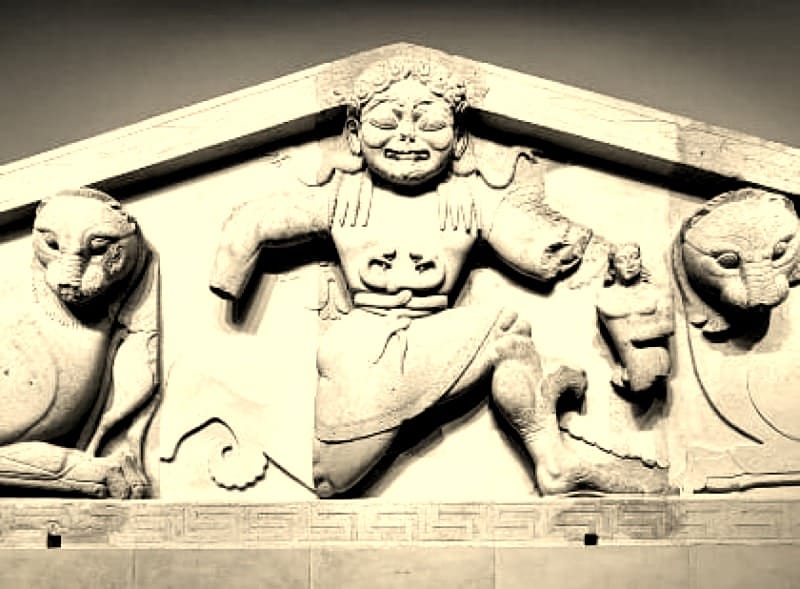
his art was an appropriation of a symbol of the Goddess, whom they were previously depicted as peacefully flanking. Readers may be familiar with the seated icon of Çatalhöyük, or the Medusa pediment from Artemis’s temple on Corfu Island. Lions, or more often lionesses, function as zoomorphic symbols of her intrinsic power and authority, and that anchor her to the raw vital forces of the natural world. The ancient imagery features the woman and the lion in cooperative, calm alignment. Nature recognized her authority, and no blood had to be spilled.
In the same way, the violent culture of empire commandeered the relationship with nature into a violent interaction, hunting of most indigenous people is not for sport or such a bloody violent proposition as portrayed by these “hunters.” People hunted, but they didn’t play with or torture the animals that would serve as their food.
The King's Appropriation: The king's message was the exact opposite of alignment with the natural flow. He was saying: "I do not cooperate with the wild. I conquer it. I do not harmonize with the apex power of the earth; I destroy it, spill its blood on the dirt, and step on its neck."
By killing the lion in such a cruel way, the king was visually demonstrating that the old, egalitarian, peaceful framework of ecological kinship was dead, and that his new, artificial apparatus, the standing army and the state, was now the supreme force on earth. Once the kings broke the old relationship, they literally stole the lion to use as their own corporate logo.

They took the lioness off the goddess's birthing throne and carved giant, aggressive, winged lions with human male faces (lamassu) to guard the gates of their military palaces in Nineveh. The message shifted from "The lion represents shared, wild life-force" to "The lion is now the terrifying weapon of the king, and if you rebel against our trade taxes, this is the violence that will destroy you."
The lion’s destruction was a warning to all, but its mythical echoes spoke to women directly.
Installation of the Myth of Male Dominance
Roland Barthes described myth as a way of making history, no matter how depraved, appear natural. A metaphor like ‘Hunter’ or ‘Nimrod’ vibrates in ways that shift over millennia. The Assyrian propaganda machine explicitly pushed the narrative: "Our king is a Mighty Hunter, protected by the gods, and that is why he has the right to hunt and conquer you." This one deliberately slithered out of plain sight. It has two meanings - hunting, but not in the human natural meaning of hunting with respect for nature, but as bloodthirsty sport. "Hunting" meant hunting people, as in war. “Man the hunter” is a euphemism for something more violent that sounds noble.
Might makes right. As the Assyrian state scaled its military and stabilized its trade routes, it used increasing, legalized violence to ensure absolute subjugation, not just at the borders and trade gates, but inside the family structure itself by dictating domineering gender roles for men and forcing submissiveness on women. The foundational codes of early civilization were not a triumph of order over chaos, but a barbaric apparatus designed to enforce male monopoly through state-sanctioned terror. Before Assyria fell in the 600s BCE, it was built on legal codes from previous empires. As Gerda Lerner demonstrated in The Creation of Patriarchy, Mesopotamian rulers, including the Akkadian, Old Babylonian, Hittite, and Persians in the area 1700-1800 years previously all handed down a series of laws that were honed and perfected to enslave people, women first and most of all.
The Legalization of Crimes against Women and Conquered Peoples
Some of the earliest of these legal codes normalizing governance by male terror can be found in the Urukagina Liberty Cone Inscriptions, (ironically named for the Sumerian text for “freedom” or “return to the status quo”). Apparently some rulers had eased up on their subjugation of women citizens, and many women had accumulated land and wealth. These cones were out to make Mesopotamia great again, and crack down on women’s freedom. Not surprisingly, the laws were referred to as wonderful reforms.
"The Reforms of Urukagin” were engraved on clay cones around 2350 BCE, in Lagash, an early trading city in Mesopotamia seriously restricting women’s freedom and economic power, lowering their status from autonomous human to property like cattle, becoming essentially the slaves of men. The righteous sounding “reforms” systematically took autonomy from women. Elite women were given power only if it were conflated within the scope of religious duties. Although engraved around the 24th century BCE, 2350 BCE, and calling themselves “reforms,” they are the earliest examples of Mesopotamian laws we have. Subsequent versions were remarkably similar, the laws of Ur-Namma (c. 21st century BCE), the laws of Lipit-Ishtar (c. 20th century BCE), the laws of Hammurabi (18th century BCE), and then the Middle Assyrian Laws (second millennium BCE).
Superficial historical commentary praises the laws as evidence of stabilization and as necessary for the unification of empire. They cite progressive protections for men and male priests (who were usurping the previously held female position) as evidence for law and order out of chaos. Violent suppression of objectors was seen as necessary for the state to grow and expand. All fine for economic continuity, but hard on the people.

The Reforms & the Return of Subjugation
These reforms were not subtle. They attacked the very humanity of women on almost every level. Although they were brazenly violent, many of these laws are the precedents and foundations of our Western legal system, toned down for modern sensibilities. You may recognize more than a few.
Violent Suppression of Speech: The cones outline strict behavioral boundaries for how a woman could interact with men. They decreed that “any woman who spoke out of turn (in opposition to being degraded as a woman) would have her teeth smashed with a baked brick." To maximize the terror, that bloodied brick was then hung at the city’s main gateway. Every woman entering the marketplace or walking through the city would look up, see the brick, and understand the physical consequence of speaking up or challenging a man. To this day there are things that women cannot say that men can.
Beginning of the Nuclear Family: Urukagina brags about abolishing polyandry (the ancient practice of a woman taking multiple husbands), decreeing that if a woman tried to do this today, her punishment was to be stoned and thrown into a pit. This was a legal invention of a double standard to guarantee male ownership over lineage. No such law was passed for men. Men were completely free to practice polygyny (having multiple wives) or keep concubines. A man having sex with multiple women didn't confuse his property lines; it just created more heirs or laborers. To this day there are double standards for men’s and women’s sexual encounters outside of marriage.
By framing polyandry as a heinous "crime" punishable by public stoning, Urukagina wasn't promoting a universal ideal of marital fidelity. The king was legally stripping women of their traditional, tribal right to hold multiple partners, locking them into a state-regulated system of monogamy where a woman's reproductive capacity was converted into the exclusive, private property of a single male head of household. The nuclear family was decreed as mandatory law at this time of the incipient empire.
First Anti-Abortion Laws per "The Reforms of Urukagin” : (Law A 53) states that if a woman intentionally terminates her pregnancy ("drops that which is in her"), she has committed a heinous crime against her husband’s property rights. The penalties were extreme including impalement on a stake of the condemned woman and denial of burial. In Mesopotamian religious belief, leaving a body unburied meant the person's ghost (etemmu) could never rest or descend to the netherworld, condemning her soul to eternal, wandering torment.
Meanwhile, if a father wanted to practice infanticide (discarding a newborn child), that was his legal right as the patriarch. But if a woman aborted a pregnancy, she was seen as "stealing" or destroying her husband's prospective heir.
Earliest Veil Laws are found on the cones (Law A 40): This is the oldest known law ordering public veiling in human history. Crucially, it was used as a class marker to denote male ownership. Respected wives, daughters, and concubines must wear a veil in public to show they belonged to a protected citizen. Conversely, slaves and prostitutes were strictly forbidden from veiling. If an unauthorized woman or slave was caught wearing a veil, she was subjected to 50 blows with rods and had boiling pitch poured over her head.
Legalization of Domestic Abuse: These laws explicitly granted husbands total physical dominion within the household and over women’s bodies. A text from the code stipulates: "A man may whip his wife, pluck out her hair, mutilate her ears, or strike her; it bears no penalty." That was for any reason, but if a woman was caught committing adultery, the husband had the legal right to cut off her nose or ears, or execute both his wife and her lover on the spot.
The birth of Western Civilization began one long horrific trauma narrative. Even though the empires decreeing these barbaric laws all came and went, they served as the template for economic extraction and organized military terror from later Middle Age to modern empires. The raw organized coercive violence was toned down into a more subtle, but more permanent, civil bureaucracy and ostensibly defensive standing armies. In short, public disfigurement was not a pragmatic solution to domination because it exposed the human commodities to possible infection, was an admission that your control is fragile and requires terror to maintain, and could possibly elicit a martyr effect and produce an uprising. Systemic codification became preferred to overt barbarism to rationalize violence as the law and to make objections seem mad and unreasonable, hysterical. By transforming misogyny into a bureaucratic process (divorce laws, property rights, modesty codes), the state can dehumanize women under the guise of "fairness and due process." Later empires adopted the foundational Assyrian concept of treating women’s bodies as state-regulated private property and by time of Aristotle, misogyny was normalized and considered reflective of human nature.
1860s–1910s: The West Invents the Violent Caveman to Justify Empire
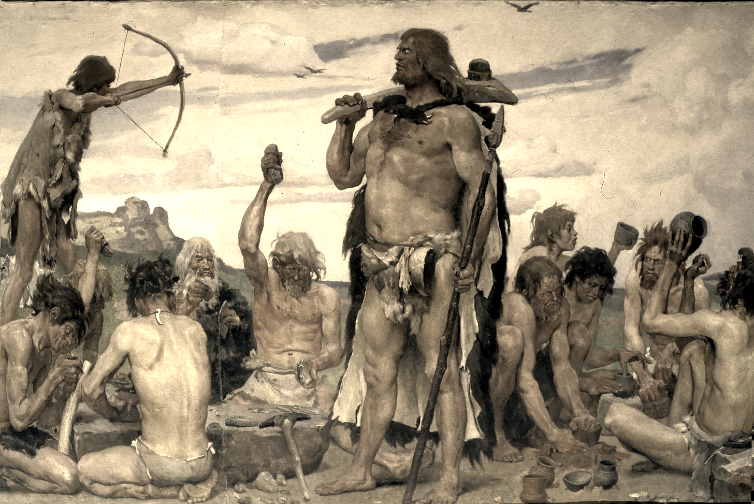
The image of the prehistoric human as a club-wielding, bloodthirsty stalker is a cultural fiction manufactured in the 19th century. When Charles Darwin published On the Origin of Species in 1859, the new fields of archaeology and paleoanthropology were blooming, but lacked the fossil evidence required to reconstruct early human behavior. To fill this vacuum, and help justify a new “golden age” of empire and discovery they equated with the Greeks, Victorian scientists, legal theorists, and artists projected their own societal realities, namely unfettered industrial capitalism, violent imperial expansion, and rigid patriarchal dominance, backward in time.
John Lubbock (Baron Avebury)
If one person codified the "brutish, bloodthirsty primitive" into scientific literature, it was John Lubbock in his monumental 1865 book, Pre-historic Times. Lubbock essentially invented the cultural caricature of the Paleolithic "caveman." He argued that modern indigenous foraging societies were living "fossils" of early humanity and explicitly described prehistoric humans as wretched, violent, and entirely lacking in moral restraint or cooperation. His writings directly inspired the influx of Victorian paintings depicting club-wielding brutes led by an ‘alpha male.’
Thomas Henry Huxley ("Darwin's Bulldog")
While Charles Darwin was cautious about applying evolution to human social behavior, T.H. Huxley was not. In essays like Evolution and Ethics (1893), Huxley popularized a deeply Hobbesian view of nature and human origins. He argued that the earliest human state was a "continuous free fight," a brutal warfare of individuals against individuals where the "bravest, the strongest, and the shrewdest" survived. This provided the exact "killer instinct" framework that Dart and Ardrey later plagiarized under the guise of anatomy.
By framing early human history as a continuous state of war and competition, the Victorian elite protected their patriarchy in two ways: 1) Globally, it established a linear, racist ladder of evolution where contemporary Indigenous societies were categorized as inferior "living fossils" who required paternalistic Western rule to "progress." 2) Domestically, it naturalized systemic violence, resource hoarding, and social inequality by claiming that human nature is fundamentally competitive rather than cooperative. When 20th-century scientists like Raymond Dart formalized the "Killer Ape" hypothesis, they were not uncovering objective prehistoric truths; they were retrofitting the imperial myth into the fossil record.
1950s–1970s: Anti-Colonial and Post-Colonial Theorists Expose the Psychological Projection of the "Primitive"
A number of thinkers and feminists pushed back against this Victorian killer ape version of “Man the Hunter.”
Frantz Fanon: analyzed the psychological mechanics of the colonial mindset, and demonstrated in his 1961 book The Wretched of the Earth how European empires had to structurally invent a "pre-rational, violent native" to justify the extreme violence of the colonial enterprise towards Indigenous peoples.
Donna Haraway, author of Primate Visions: Gender, Race, and Nature in the World of Modern Science, (1989), wrote the definitive text on how primatology and paleoanthropology were saturated with colonial and patriarchal anxieties. She meticulously showed how Western scientists projected narratives of white supremacy, corporate competition, and the Cold War onto the social structures of apes and early hominids.
Martha McCaughey wrote The Caveman Mystique ( 2007) tracing how this 19th-century colonial myth evolved into 21st-century "Pop-Darwinism." She analyzed how modern media and Evolutionary Psychology continue to use the manufactured caveman archetype as a biological defense to excuse male aggression, entitlement, and corporate ruthlessness.
1966, Year of the Re-Emergence of Man the Hunter
In 1966, the academic establishment attempted to reverse engineer the Mesopotamian “Great Hunter” script of the early empires. Never mind, 4,000 years previous is still several million years too little and too late in the human historical timeline to affect evolution, the intent was to establish permanent biological law. In the mid-20th century, most scientists understood this, and were beginning to erode the assumption that humanity organized around powerful male hunting and war figures. New research was emerging in favor of the theory that most of early human occupation was spent foraging and cooperating.
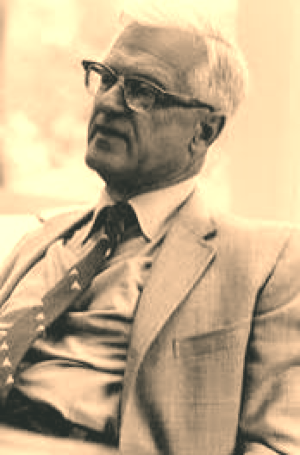
Young anthropologists Richard B. Lee and Irven DeVore were asked by their mentor, Sherwood Washburn to organize a conference on these matters in 1966 (yes the same year Friedan published The Feminine Mystique). Washburn was a towering, old-school physical anthropologist who engineered the modern evolutionary framework for primate and human behavior. He aggressively pushed the narrative that big-game hunting was the only biobehavioral system that could explain human bipedalism, tool-use, and large brains.
Hunting, you see, gave us Aristotle, at least for the educated in the Middle Ages and Victorian England. Part of the gatekeeping of academia and Victorian England was a fascination with the ancient Greeks. In Aristotle’s Nicomachean Ethics, he mansplained that people are not born virtuous by default, so they require habit, culture, and education (of patriarchy) to develop moral character. Although he considered humans capable of great virtue when guided by reason and law, women and indigenous people he considered devoid of reason and therefore needed laws to control them. Aristotle’s speculation that a human separated from law and justice becomes "the worst of all" animals, was superimposed retroactively by the Victorians on to our most ancient ancestors as the brutish, violent hunter of a cave man.
Washburn, in the classical Greek by way of Victorian sensibilities, co-authored the foundational essay The Evolution of Hunting for the 1966 symposium and forced Lee and DeVore, under objection, to name the conference “Man the Hunter” to favor his paper. Washburn favored the thesis that the evolution of human intelligence grew from confronting the complexities of hunting big game. Ironically, the other invited research was filled with field data refuting Washburn’s hypothesis and showing that the foraging and gathering done by women provided 60% to 80% of the community's total calories, and that hunting was an unreliable prospect for an evolutionary driver of human intelligence, brain size, or social organization. A book of the collected abstracts of the conference was printed as is custom for such conferences, entitled, Man the Hunter, instead of cementing the myth, it angered and inspired a generation of feminist anthropologists, archaeologists, and thinkers who looked at that title and knew the actual numbers to go to war against a weaponized scientific hypothesis Anthropologists such as such as Sally Slocum (author of the foundational counter-thesis "Woman the Gatherer"), Eleanor Leacock, and Adrienne Zihlman.
Early Humans Were Not Primarily Hunters
Evidence shows scavenging as a way of procuring meats preceded active hunting. The reality is that both men and women foraged and scavenged. Diets were omnivorous, not carnivorous, and as flexible as the gender roles.
During the 1960s, Lewis Leakey was among the earliest paleoanthropologists to suggest that small, lightly built hominids like Homo habilis lacked the physical size and weaponry to hunt big game and likely scavenged instead. Analyses of animal remains from archaeological sites like Olduvai Gorge in Tanzania revealed both stone tool cut marks with carnivore tooth marks overlapping on the same bones, indicating hominids were carving up carcasses after larger predators had already eaten.
Pat Shipman, an anthropologist in the 1980s, used scanning electron microscopes to examine these same fossilized bones. Her microscopic analysis of cut marks and tooth marks at Olduvai Gorge strengthened the evidence for the theory that scavenging was a primary meat-procurement strategy between 2 million and 1.7 million years ago.
In more recent decades, Smithsonian paleoanthropologist Briana Pobiner conducted modern ecological simulations in Kenya to refine the theory. Her work demonstrated that "passive scavenging" from lion kills could yield thousands of calories in leftover scrap meat, providing enough energy to support early human brain and body growth.
The myth was not going to surrender easily. The conference provided the illusion of academic authority, the "scientific" cover for an insidious pop-culture pipeline feeding the media and our popular perception of who we are right now.

The actual ideological engine that took this compromised academic framework and injected it into global pop culture wasn't the published abstracts of the conference (which indicated the opposite of the title “Man the Hunter,” it was highly successful Hollywood screenwriter turned pop-ethologist named Robert Ardrey credited with prominent films like Khartoum and Three Musketeers. Ardrey approached anthropology not with constraint or caution of peer reviewed science, but with the raw instincts of a dramatist seeking clear heroes, violent conflict, and fatalistic resolutions.
Ardrey authored two international bestsellers: African Genesis (1961) and The Territorial Imperative (1966) spinning highly flawed theories of killer apes. He took Washburn’s "man the hunter" theory into fringe areas, aggressively arguing that human beings only evolved because our primate ancestors became bloodthirsty, weapon-wielding carnivores. Screenwriter and director, Stanley Kubrick became utterly obsessed with Ardrey, famously sleeping with Ardrey’s books stacked directly on his nightstand.
Two years after the Chicago symposium, Kubrick put his nightstand books onto every cinema screen in the world with his 1968 masterpiece, 2001: A Space Odyssey. The film’s iconic "Dawn of Man" opening sequence tells Ardrey’s exact lie in a single, wordless cinematic sequence: a primitive ape looks at a pile of bones, realizes it can use a club to kill an animal for meat, and then uses that same weapon to murder a rival ape at a watering hole. In a burst of masculine triumph, the ape hurls the bone into the sky, and Kubrick famously cuts directly from the falling bone to a nuclear-era space station floating in orbit, a thinly veiled comment on human nature, “See, we haven’t changed a bit”.
Cold War Fatalism and Kubrick’s Monolith
This dramatized fiction solved a massive psychological dilemma for the Western world during the Cold War. Facing the terrifying prospect of global nuclear annihilation, society was desperate for a narrative that absolved them of political and systemic guilt. If human beings were genetically programmed killer apes, the threat of atomic bombs, the horrors of world wars, and the brutality of global empires were not failures of policy, leadership, or economic design. They were simply inevitable biology.
The message was unmistakable and deeply toxic: human intelligence, technology, and civilization were birthed directly from male violence and lethal weapons. The Manosphere as evolutionary advantage. Kubrick laundered a screenwriter’s pop-science fantasies into a multi-million-dollar cultural monument, convincing generations that we only reached the stars because our fathers learned how to kill.
It’s clearly a straight line from game hunting to Aristotle to space travel, right? The ‘unspoken’ meaning of this clear line is that men hunted, therefore men reasoned, therefore men became astronauts, and women who gathered and looked after babies remained less … human. This myth is going to die.
Facts Don’t Care About Feelings
But forty years later, the feminist scholarship sparked by the Chicago symposium, combined with modern archaeology, genetics, and evolutionary biology, walked into the room and blew that entire cinematic illusion to pieces. Popular culture hasn’t caught on yet that it’s following a zombie myth, it’s still following the “apex predator” myth, the sci-fi fantasy version of “man the hunter.”
The "Man the Hunter" narrative has been dismantled by hard data:
- Shield Maidens: For over a century, the famous 10th-century Birka Viking warrior grave in Sweden was held up by male historians as the ultimate example of a fierce, elite male commander. In 2017, DNA testing proved the skeleton was indisputably female. This finding sparked a flurry of modern re-analyses across Scandinavia and ancient Eurasian steppes, proving that up to half of these legendary, weapon-wielding warriors were actually women, and not, based on cultural biases, 100% male as previously assumed.
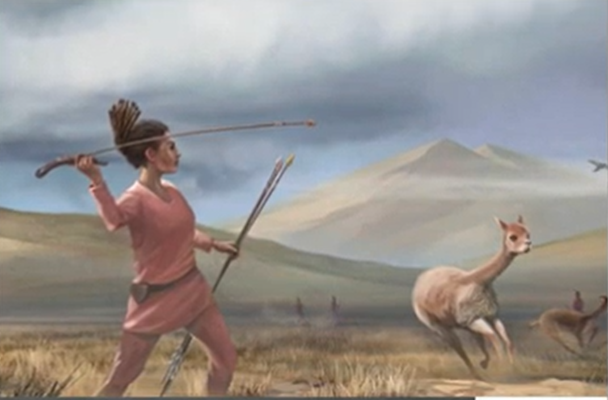
- 9,000-Year-Old Surprise: In 2020, archaeologists at the site of Wilamaya Patjxa in Peru unearthed the remains of a 9,000-year-old big-game hunter buried with a toolkit of spear points and processing tools. DNA analysis proved the hunter was female. Shocked, researchers re-analyzed late Pleistocene and early Holocene burials across the Americas, only to discover that between 30% to 50% of big-game hunters were women. Early hunting wasn't a male monopoly; it was entirely gender-neutral.
That's two strikes against violence being men’s business, but not against violence/hunting being a prompt for our intellectual evolution.
That myth came under more pressure with research like that of Sarah Blaffer Hrdy showing the prevalence of cooperation among our primate ancestors. In her groundbreaking work on cooperative reproduction, Hrdy proved that what actually allowed humans to evolve massive, energy-hungry brains and bipedalism wasn't isolated male hunting or violence. It was alloparenting—the cooperative childcare networks, shared gathering, and collective protection managed by mothers, grandmothers, and clan members.
Hrdy shows us that real and on-going complexity of organizing social life and enculturating children would play at least as much role in our intellectual leaps, while other research has shown us now that violence is not men’s alone or even their deepest nature. Alloparenting keeps men involved in childrearing, too.
Alongside Sarah Blafer Hrdy other women evolutionary anthropologists and primatologists who added to the data that human beings were cooperative rather than violent apex predators include:
The Grandmother Hypothesis: developed by Kristen Hawkes argues that post-menopausal women drove human evolution by foraging for food to feed their grandchildren. This extra food allowed mothers to have children more frequently and helped human brains grow larger.
Cooperative female reproductive and social networks shown by Karen L. Kramer to enable early humans to raise multiple dependent children at once in her cross-cultural ethnographies. Her work revealed a cooperative structure to enable human evolution rather than a competitive one. She demonstrated that women build flexible, non-kin coalitions for food production and childcare.
Collective hunting and gathering (including contributions from children and elders) was shown by Alyssa Crittenden. studying the Hadza hunter-gatherers in Tanzania, to shape human life history and social bonds.
If We Are Not ‘Man the Hunter,’ Who Are We?
The answer draws on contemporary Indigenous societies and on scholars like Heide Göttner-Abendroth’s structural definition of matriarchy: egalitarian, consensus-oriented societies that exist today, proving that a care-based human social system is not a myth.

Living contemporary matriarchies still practice alloparenting as they have for millennia, consider grandmothers and elders invaluable resources, and maintain stable communities around the globe who prioritize care and preservation of life. They stand as irrefutable examples of Hrdy’s cooperative hypothesis, and as rebukes to the patriarchal trope that it is man’s violence that gives us meaning. Centuries of patriarchal scholarship have deliberately lied about the word, concept and existence of “matriarchy.” The idea of egalitarian societies, if acknowledged at all, was framed as a mythological mirror-image of patriarchy where women rule over men through coercive force. That has clearly been shown to be a projection of the patriarchal mind.
To understand what a matriarchy actually is, it helps to understand the word’s Greek etymology. The word combines matri (μήτρα / mḗtr), meaning matrix, womb, and the source of life, compassion, and care (the same root that gives us "matriculate"); with arche (ἀρχή / archē), meaning first principles or origin (as in "archetype").
Matriarchy is a society that prioritizes the first principles of compassion, care, and the protection of life.
Patriarchy, by contrast, relies on a much later, distorted Latin adaptation that twists arche into top-down, coercive "rule." Patriarchy means the rule of the father; matriarchy means a society anchored in the matrix of collective care. In contemporary matriarchies existing today, power is not centralized or weaponized. It is a sophisticated political system where power is shared, consensus replaces domination, property flows matrilineally, through the daughters, and the economy is driven by a singular mandate: ensuring the most vulnerable are cared for first. Wealth is measured not by what an elite class accumulates, but by what the collective distributes.
A myth glorified the necessary violence of the death-regeneration-life cycle and the need of all living things to eat into a social first principle: I hunt therefore you serve.
From the clay cones of Mesopotamian tyrants who literally said “might makes right,” to the Aristotelian accusation of only the basest forms of humanity to exist without patriarchy reinforced by the Victorians and old school academia, to the glorification of killer apes by screenwriters like Robert Ardry and Stanley Kubrick, and the sci-fi horror imagery of apex predator, the dominant power structure has weaponized a lie. They told us that human intelligence, technology, and civilization were birthed from masculine violence, the myth of "Man the Hunter."
But the curtain has been pulled back.
Evolutionary anthropology proves that we did not survive because a lone, aggressive primate picked up a bone to smash his neighbor's skull. We survived because a collective network of caregivers kept each other alive. Our massive brains, our bipedalism, and our capacity for complex language did not evolve from stalking prey on the savanna; they evolved from alloparenting, mutual trust, and the principles of collective care. And that care does not require our return to archaic ways of life or the ever present boogeyman of socialist impoverishment.
The multi-billion-dollar sovereign health systems of the Cherokee Nation and the land trusts of the Ohlone matriarchs are proof that humanity is entirely capable of being modern, industrious, and wealthy without abandoning the care-based foundation Hrdy uncovers in our ancient past. We do not need to look forward to an imaginary, utopian future to find our freedom. We simply need to rematriate the West, humble ourselves to learn from the living frameworks that the empire failed to wipe out, and reclaim our original baseline: a species designed to protect, nurture, and sustain life.
Here in Part 1, I’ve debunked the pervasive myth of human aggression and violence dominated by men, the pervasive myth of universal patriarchy, “Man the Hunter” through story, through law, through wishful thinking and how that myth has unraveled over the past 4,000 or so years in the face of the very rationality and science Man wanted to claim hunting prompted from the male mind. Patriarchy dies by a thousand ironies.
In Part 2, I will take us out from Man the Hunter and examine indigenous cultures who were almost decimated by their encounter with “Man the Hunter’s” colonization and are currently, in their words, “rematriating” their cultures to pre-colonial endurance, wisdom and creative adaptation to inspire feminists again and again.
Dr. Lila Laponi is a feminist medical anthropologist, educator, and public policy researcher whose career was dedicated to advancing women’s health at all levels of public service. Her work in epidemiology and public policy lends a deep understanding of interconnection among systems. Her life's work explores what makes us human while actively challenging the structures of hierarchy and patriarchy. She’s the admin at r/MatriarchyNow! and contributes to Matriarchy Civilization on Substack. Outside of her writing and research, you can usually find Lila managing a neighborhood cat colony, building a permaculture garden, knitting, or making pizza for neighbors.
Please support this and other feminist work.
Choose a tier, first months always free. Click here.
References
- Ardrey, R. (1961). African genesis: A personal investigation into the animal origins and nature of man. Atheneum.
- Ardrey, R. (1966). The territorial imperative: A personal inquiry into the animal origins of property and nations. Atheneum.
- Bachofen, J. J. (1861). Das Mutterrecht: Eine Untersuchung über die Gynaikokratie der alten Welt nach ihrer religiösen und rechtlichen Natur [Mother right: An investigation of the gynecocracy of the ancient world in its religious and juridical nature]. Verlag von Benno Schwabe.
- Barthes, R. (2013). Mythologies: The complete edition, in a new translation (R. Howard & A. Lavers, Trans.). Hill and Wang. (Original work published 1957).
- Boehm, C. (1999). Hierarchy in the forest: The evolution of egalitarian behavior. Harvard University Press.
- Croucher, K., et al. (2023). The myth of man the hunter: Women’s contribution to the hunt in foraging societies. PLOS ONE, 18(11).
- Gage, M. J. (1893). Woman, church, and state: A historical account of the status of woman through the Christian ages: With some considerations of its effects upon Christian civilization. The Truth Seeker Company.
- Gavrilets, S. (2012). On the evolutionary origins of the egalitarian syndrome. Proceedings of the National Academy of Sciences (PNAS), 109(35), 14069–14074.
- Göttner-Abendroth, H. (2012). Matriarchal societies: Studies on indigenous cultures across the globe. Peter Lang.
- Graeber, D., & Wengrow, D. (2021). The dawn of everything: A new history of humanity. Farrar, Straus and Giroux.
- Haas, R., et al. (2020). Female hunters of the early Americas. Science Advances, 6(45). (Note: Adjusted from 'Science' to the exact journal 'Science Advances' for absolute precision).
- Hrdy, S. B. (2011). Mothers and others: The evolutionary origins of mutual understanding. Harvard University Press.
- Lerner, G. (1986). The creation of patriarchy. Oxford University Press.
- Lewis, J. (2016). Egalitarian societies with Jerome Lewis [Video]. YouTube.
- McCaughey, M. (1997). Real knockouts: The physical feminism of women’s self-defense. New York University Press.
- Murdock, M. (1990). The heroine's journey: Woman's quest for wholeness. Shambhala Publications.
- Sanday, P. R. (1981). Female power and male dominance: On the origins of sexual inequality. Cambridge University Press.
- Sanday, P. R. (2002). Women at the center: Life in a modern matriarchy. University of Pennsylvania Press.
 Chip
Reach out anytime for any reason: info@medusarising.org.
Find us everywhere you are with the social web: @gorgons@medusarising.org.
( ^-^)ノ∠※。.:*:・'°☆ ( ^-^)ノ∠※。.:*:・'°☆ ( ^-^)ノ∠※。.:*:・'°☆